


Europe Marches Behind Washington Again
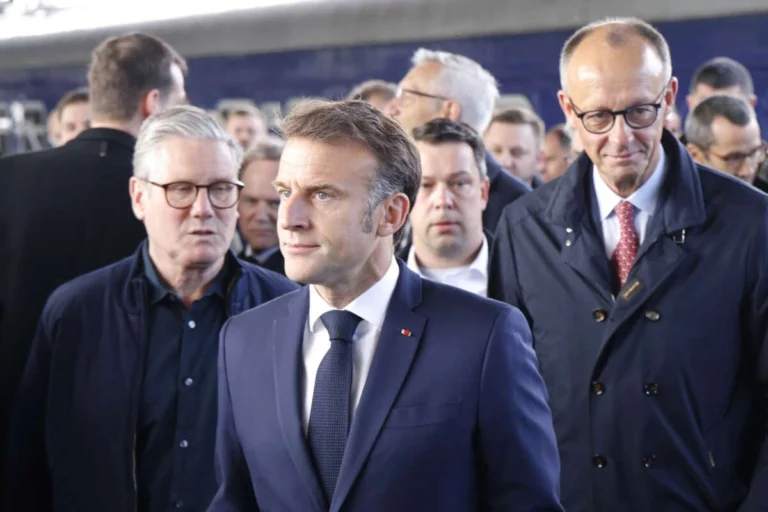
U.K. Prime Minister Keir Starmer, French President Emmanuel Macron, and German Chancellor Friedrich Merz. Photo: TruthOut
March 2, 2026 Hour: 2:27 pm
🔗 Comparte este artículo
From Starmer’s base access to Macron’s nuclear buildup, the EU core trades strategic independence for deeper integration in the Iran war.
The Middle East’s geopolitical landscape has reached a violent turning point following the launch of “Operation Epic Fury,” a joint military offensive led by the United States and Israel against Iran.
RELATED:
Iran Supreme Leader’s Wife Dies After Two Days in Coma
The operation resulted in the confirmed death of Leader of the Islamic Revolution Sayyed Ali Khamenei and has sparked a significant regional escalation that is altering the strategies of global powers.
Although Western intelligence services describe the offensive as a necessary strike against underground command centers, the human cost has already been devastating.
One of the most shocking consequences of the initial wave of bombings was the destruction of the Shajareh Tayyebeh girls’ school in Minab, Iran.
According to reports, a precision air-to-surface missile hit the school, killing around 165 students. The attack quickly became a symbol of resistance in Tehran and a focal point for international condemnation of the violation of humanitarian law.
As Iran responds with its Fattah 2 hypersonic technology, the conflict is shifting from a low-intensity shadow war to an open, high-tech confrontation.
The European Core: From Strategic Autonomy to Imperial Subservience
In the 24 hours following the escalation, the European “hard core” swiftly moved toward active military preparation and logistical alignment with the U.S.-led bloc.
This shift represents a significant departure from previous calls for European strategic autonomy, as the dominant powers now focus on neutralizing Iran’s ability to retaliate.
British Prime Minister Keir Starmer officially confirmed that the United Kingdom will allow U.S. forces to use British bases to attack Iran.
This represents a definitive policy shift; initially, the UK denied such access due to concerns about violating international law. Starmer now presents this cooperation as a “defensive” necessity aimed at stopping Iranian missile launches.
France has adopted an especially aggressive posture under President Emmanuel Macron. Speaking from the L’Île Longue submarine base, Macron ordered an historic increase in France’s nuclear warhead arsenal and emphasized that France will use any means necessary to defend its “vital interests” in the region.
The French government has also declared its readiness to actively defend Gulf allies, including Saudi Arabia, Qatar, and Jordan, against potential Iranian retaliation.
France, Germany, and the UK form the E3 group, which is now considering preemptive strikes. These operations would target drone and missile launchers within Iran, aiming to neutralize the Fattah 2 hypersonic cruise missile before it can be used against Western infrastructure.
Ursula von der Leyen, president of the European Commission, has departed from traditional diplomatic language by openly calling for a “credible transition of power” in Tehran.
By presenting the post-Khamenei period as an opportunity for “democratic aspirations,” the EU is aligning itself with the goal of systemic change in Iran.
Von der Leyen has maintained constant contact with regional leaders to express “full solidarity” against what she describes as “irresponsible” Iranian actions.
The Arab Coalition: Sovereignty and the “Security Umbrella”
Following the events of late February, the geopolitical alignment of the Persian Gulf states evolved into a formal coalition against Tehran.
Saudi Arabia has emerged as the main driver of this bloc, supporting the offensive discreetly while publicly maintaining a façade of diplomatic neutrality.
Following Iranian retaliatory strikes on the Ras Tanura refinery and Saudi Arabia’s capital city of Riyadh, the Saudi government denounced these actions as “flagrant violations” of its sovereignty. They also announced their readiness to join an international coalition to protect Arab states.
The United Arab Emirates and Bahrain have echoed this position. Bahrain has reported casualties from debris from intercepted missiles and from an attack on a U.S. Fifth Fleet service center located on its territory.
The UAE has reported intercepting more than 200 drones and missiles and strongly condemned strikes near civilian areas such as Palm Jumeirah, calling them a “dangerous escalation.”
Despite the unified message presented at the emergency Gulf Cooperation Council (GCC) meeting on March 1, the coalition is marked by internal nuances regarding the presence of Western forces.
Qatar and Kuwait, which host critical U.S. bases such as the Al Udeid Air Base, have reported bombings of these facilities and subsequently closed their airspace to contain the fallout.
Jordan has also condemned the use of its territory for ballistic maneuvers, presenting itself as a defender of Arab sovereignty against what it describes as “Iranian aggression.”
Oman, however, remains a notable exception to this regional alignment. Oman’s foreign minister, Badr Albusaidi, expressed regret over the U.S. and Israeli strikes.
The Axis of Resistance: Technological Defiance and Regional Mobilization
In the wake of the decimation of its leadership, Iran has sought to demonstrate the integrity and potency of its military capabilities by deploying the Fattah 2 hypersonic cruise missile in combat for the first time.
This weapon uses a hypersonic glide vehicle designed to maneuver within the atmosphere and bypass the anti-missile defenses now being reinforced by the United States and its European allies.
Tehran has exploited the “martyrdom” of Khamenei and the Minab school massacre to justify these high-tech strikes, which have targeted U.S. bases within a 1,500-kilometer radius.
This technological leap suggests that Iran is preparing for an open war of attrition, relying on precision weaponry to challenge the Western “security umbrella” that has long dominated the region.
Mobilization is not limited to Iran’s borders. Across the region, the “Axis of Resistance” is preparing for a multi-front escalation. In Lebanon, Hezbollah has confirmed the deaths of several fighters in recent border clashes and warned of a “rain of precision missiles” in the event of a ground invasion.
Meanwhile, the Houthi movement in Yemen has pledged its support to Tehran and threatened to expand its operations in the Red Sea against the “aggressor coalition.” This regional coordination is accompanied by an intense wave of civil unrest.
Violent protests have erupted at the U.S. consulate in Karachi and in Baghdad’s Green Zone. Clashes between Iraqi police and civilians reflect a deep rejection of the U.S.-Israeli-Saudi alliance.
Although Russia and China have officially called for “maximum restraint,” Moscow has described the operation as a “reckless gamble” by the Trump administration.
Dissent within the West: The Loneliness of International Law
Even though the “hard core” of the European Union has moved toward military alignment with Washington, the Western front is not completely unified.
Spanish President Pedro Sánchez has become one of the main dissenting voices, directly condemning the offensive.
Sánchez called the war against Iran a “breach of international law,” positioning Spain as one of the few Western countries that prioritizes protecting the global legal order over military intervention.
His stance is reinforced by reports from human rights organizations and legal experts who cite the Minab school massacre as evidence that the U.S.-Israeli offensive disregarded the fundamental principles of distinction and proportionality in international humanitarian law.
This internal Western tension mirrors criticisms from Moscow and Beijing, where the operation is seen as a “reckless gamble” that undermines multilateral frameworks and violates Iranian sovereignty.
The “New Middle East” vs. a Century of Resistance
The assassination of Sayyed Ali Khamenei and the subsequent escalation have brought the Middle East to a point of no return.
The U.S.-led bloc, supported by tactical alliances in the Gulf and strategic cooperation from the UK and France, appears committed to a “New Middle East” free of the Islamic Republic’s influence.
Meanwhile, the swift establishment of a provisional council in Tehran, comprising President Masoud Pezeshkian and the Guardian Council, indicates that the Iranian state’s institutional framework is ready for a managed succession within the 50-day constitutional window.
Rather than signaling total collapse, the death of the Iranian leader is being framed by the “Axis of Resistance” as the beginning of a new phase of prolonged warfare and mass mobilization.
From the spike in oil prices linked to the Ras Tanura refinery to the closure of airspace over the Gulf, the current conflict demonstrates that attempts at imperial restructuring are inextricably linked to deep global instability.
Sources: teleSUR – Al Jazeera – RT – TASS – Xinhua – TRT – BBC – NYT
Author: Silvana Solano
Source: teleSUR